Paul A. Loomis, Ph.D.

Professor of Mathematics
Bloomsburg University
Ben Franklin Hall 207
(570) 389-4621
ploomis@bloomu.edu
Spring 2023:
Fall 2022:
Spring 2022:
Fall 2021:
Spring 2021:
Fall 2020:
Spring 2020:
MATH 225 Calculus 3
Fall 2019:
I spent 2016-17 on sabbatical, teaching OPM 381: Analytic Number Theory, MATH 634: Theory of Rings and Fields, and MATH 638: Algebra Seminar (all in Spanish) at the Universidad Mayor San Andres (UMSA) in La Paz, Bolivia from July to December. From January to May we lived in Ollantaytambo, Peru, homeschooled the kids, and travelled a bit. I gave talks at universities in Ayacucho, Arequipa, and Cusco.
Courses I teach regularly:
Other courses I teach, but not that often:
Publications:
- Una Introduccion Historica al Sistema de Criptografia RSA,
Investigacion y Tecnologia 4, No. 1 (2016), 51-56.
- New Families of Solitary Numbers,
Journal of Algebra and its Applications 14 (2015), 154004 (6 pages).
- Two Results on Sums of Cubes,
The Mathematical Gazette 95 (2011), 506-510.
- (with Florian Luca) On Totient Abundant Numbers,
INTEGERS: Electronic Journal of Combinatorial Number Theory 8 (2008), Article A6, 1-7.
- (with Michael Plytage and John Polhill) Summing Up the Euler Phi Function,
College Mathematics Journal 39 (2008), 34-42.
- An Introduction to Digit Product Sequences,
Journal of Recreational Mathematics 32 (2003-2004), 147-151.
- Degree Two Generalized Iteration of q-Additive Polynomials,
in Algebra, Arithmetic and Geometry with Applications (2004), 601-608.
- (with Matthew Severcool) The Density of Abundant Numbers,
Proceedings of SSHEMA, 2003.
- (with Mehdi Razzaghi) The Concept of Hormesis in Developmental Toxicology,
Human and Ecological Risk Assessment 7 (2001), 933-942.
-
(with S.S. Abhyankar) Equations of Similitude,
Proceedings of the Indian Academy of Sciences 109 (1999), 1-9.
-
(with S.S. Abhyankar) Twice More Nice Equations for Nice Groups,
Contemporary Mathematics 245 (1999), 63-76.
-
(with S.S. Abhyankar) Once More Nice Equations for Nice Groups,
Proceedings of the American Mathematical Society 126 (1998), 1885-1896.
Other stuff I do:
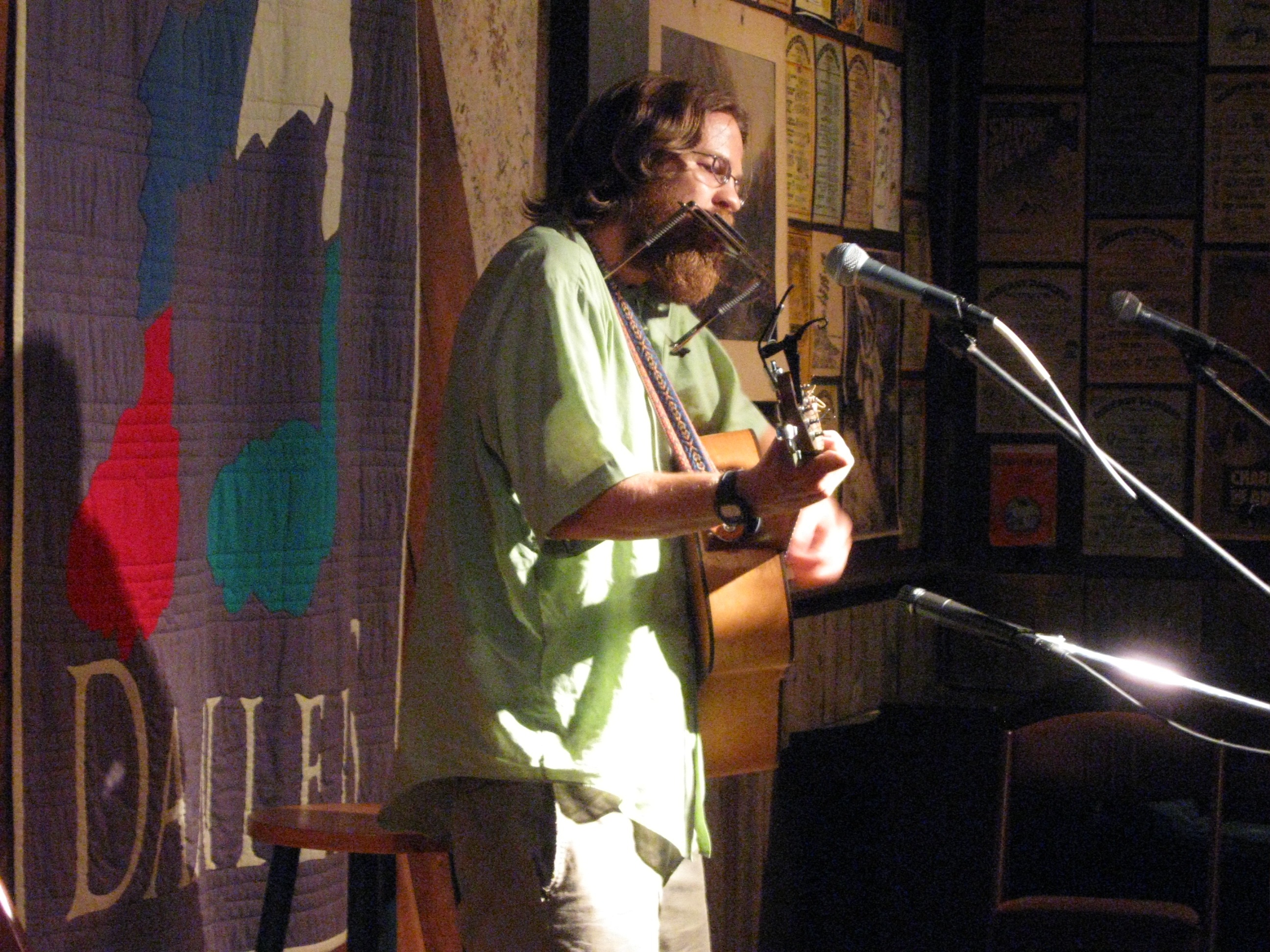
I have made three albums of original folk songs: Dry Ridge (2005), Yuspe (2009), and World Famous in Bloomsburg (2014). There is stuff about this, like how to find me playing live or how to buy an album, at paulloomis.com.
Along with my wife Leticia Weber and our kids Anna and Zeke, I spend lots of time in South America. Our blog of that trip, our other travels, and occasional posts from regular life - can be found at weberloomis.wordpress.com.
I've been a runner since 1984. To read some about that, go to my running page.